Reefer Market Alert: California Citrus Hits Shortage and Spring Produce Rates Are Climbing Fast
The spring produce season is in full swing — and if you’re moving refrigerated freight right now, the market just shifted under your feet.
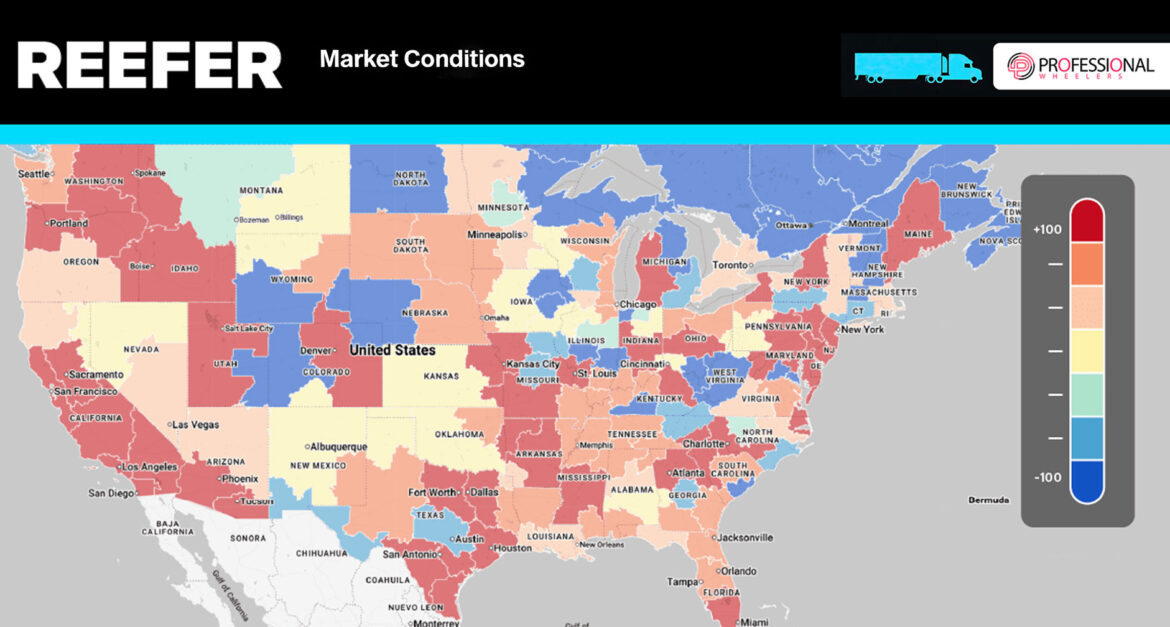
This week’s reefer market data shows capacity tightening across multiple produce regions simultaneously. For shippers, that means higher rates and fewer available trucks. For carriers, it means serious opportunity on some of the hottest lanes in the country. Either way, you need to know what’s happening before it hits your bottom line.
California Citrus Just Hit Shortage — For the First Time in 2026
This is the headline of the week. Citrus shipments out of South and Central California — blood oranges, lemons, grapefruit, oranges, and tangelos — jumped from Adequate to Shortage on all nine outbound destinations in a single week.
That’s the first shortage for any California commodity in 2026. And it didn’t happen by accident.
Storm-damaged yields earlier this season reduced overall fruit supply. Now, as the citrus season winds down, there’s less product moving — but East Coast demand hasn’t slowed. That mismatch is pushing reefer spot rates sharply higher: Seattle up 12%, Atlanta and Boston both up 11%, New York up 10%, with loads running $8,700–$9,400.
If you’re shipping California citrus eastbound, expect limited truck availability and elevated rates until the season closes out.
South Texas Is Fully Locked — For the Second Straight Week
The Texas-Mexico border isn’t cooling off. South Texas is fully locked up for the second straight week, with all nine lanes at Slight Shortage on asparagus, tomatoes, peppers, cucumbers, watermelons, and other Mexican imports moving north.
The four-week cumulative rate gains say everything — Chicago up 49%, Dallas up 47%, Atlanta up 40%. These aren’t small fluctuations. This is a sustained squeeze on one of the busiest produce corridors in the US, and it’s been building for a month.
As we covered in our Spring 2026 Truckload Market update, border lane pressure was already a growing concern heading into this season. That pressure is now fully materializing.
Shippers moving border produce to the Midwest and East Coast should plan for elevated truckload capacity costs through at least the next few weeks.
Nogales and Yakima: Both Tightening at the Same Time
Nogales, the key crossing for green beans, squash, cucumbers, tomatoes, and watermelons, tightened back up this week after a brief dip. Six of eight lanes are now at Slight Shortage. Atlanta surged 16%, and Boston lanes are approaching $10,000 per load.
Yakima Valley in Washington hit Slight Shortage on all ten lanes for the first time this year, on apples and pears. Gains are smaller — LA up 5%, Miami up 4% — but the direction is clear. Yakima is joining the national tightening trend, not bucking it.
When multiple produce regions tighten at the same time like this, it creates a ripple effect across the entire cold chain logistics network. Trucks that might normally reposition get absorbed in one region, leaving other lanes even tighter.
Florida: The One Soft Spot Right Now
Here in Florida, rates are actually running soft. Atlanta lanes fell to $1,000–$1,200 — the lowest level tracked in 2026 so far. Post-freeze crop damage means fewer loads available, keeping the market loose even though four of six lanes sit at Slight Shortage.
For Florida-based shippers, this is a real window. Outbound reefer rates from Florida are relatively affordable right now compared to the rest of the country. If you have perishable or temperature-sensitive goods that need to move, locking in reefer capacity now makes more sense than waiting. National tightening won’t stay away from Florida forever.
National Reefer Spot Rates: $2.38/Mile and Still Climbing
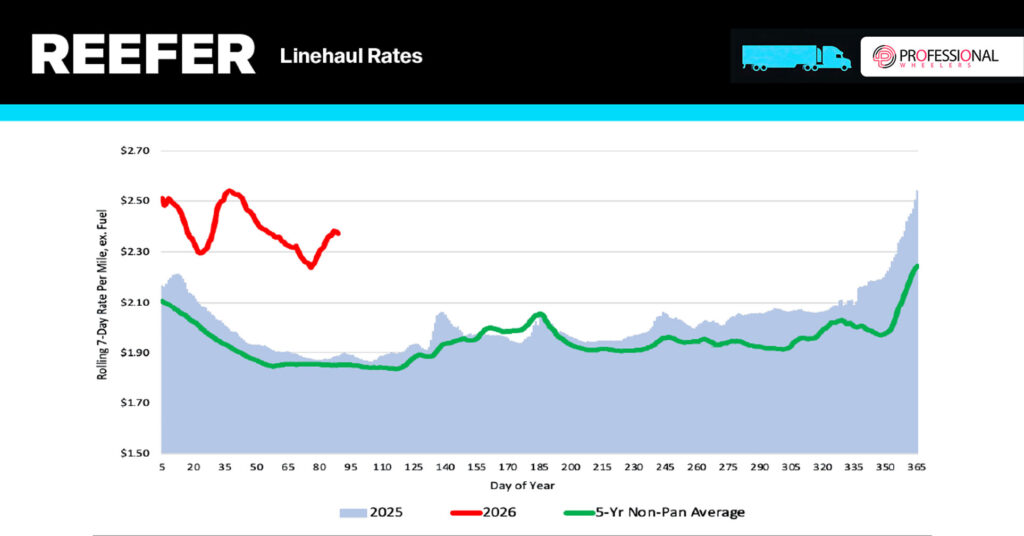
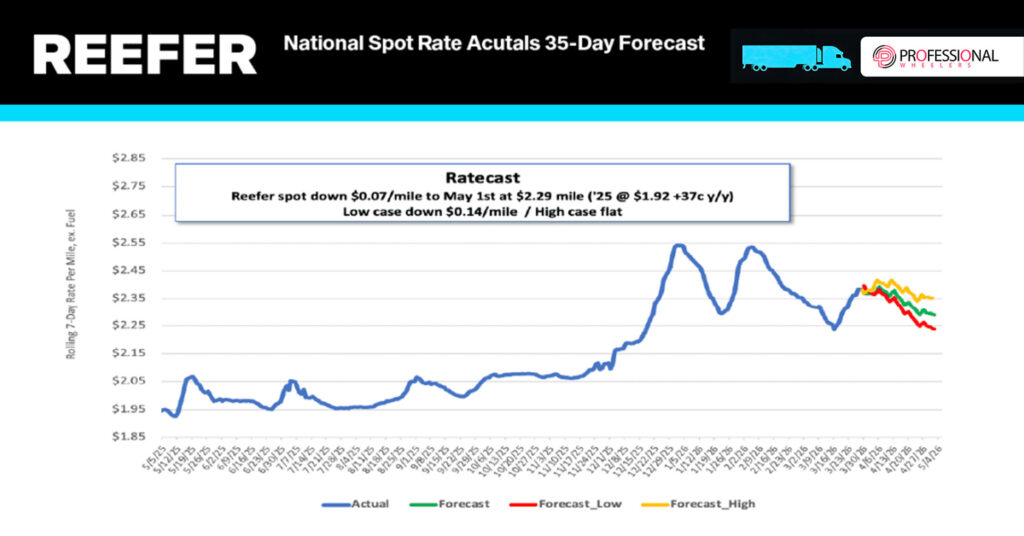
According to DAT Freight & Analytics, the national average linehaul reefer spot rate has climbed to $2.38 per mile — up $0.06 from the prior week. That’s 26% higher than the same period last year and 21% above the five-year average.
The load-to-truck ratio sits at 19.78 — still more than double what it was a year ago. As we highlighted in our 35-Day Freight Spot Rate Forecast, upward rate pressure was expected to build through spring. That forecast is playing out right now.
It’s also worth noting that carriers are recovering a larger share of rising fuel surcharges in the current rate environment — something we broke down in our piece on how the fuel squeeze is hitting carriers.
What This Means for Your Freight Right Now
If you’re a shipper: Reefer capacity is tightening fast on key produce lanes and spot rates are rising week over week. Waiting to book trucks is costing you money. The time to secure capacity is before the shortage hits your lane — not after.
If you’re a carrier or owner-operator: The reefer market is one of the strongest it’s been in years. Border lanes, California eastbound, and Yakima are all producing strong rates with consistent load availability. Position your trucks where the money is.
And if you’re moving cargo through ports, don’t overlook how drayage efficiency connects to your overall supply chain costs — read our guide on seamless port-to-door container transportation to see how to reduce dwell time and avoid unnecessary fees.
No matter your role in the supply chain, making sure your freight moves safely and on time is what separates a smooth season from a costly one.
Move Your Reefer Freight With Professional Wheelers
At Professional Wheelers, we specialize in temperature-controlled freight across the US — from California produce lanes to Florida outbound loads and everything in between. Our network of vetted reefer carriers gives you real capacity when the market tightens, not just a quote that disappears.
Whether you need a full truckload or a flexible LTL reefer solution, we’ll find the right move for your freight at the right rate.
📞 Call us: +1 (877) 885-5550 📧 Email: Info@professionalwheelers.com 🚛 Get a Free Reefer Quote →