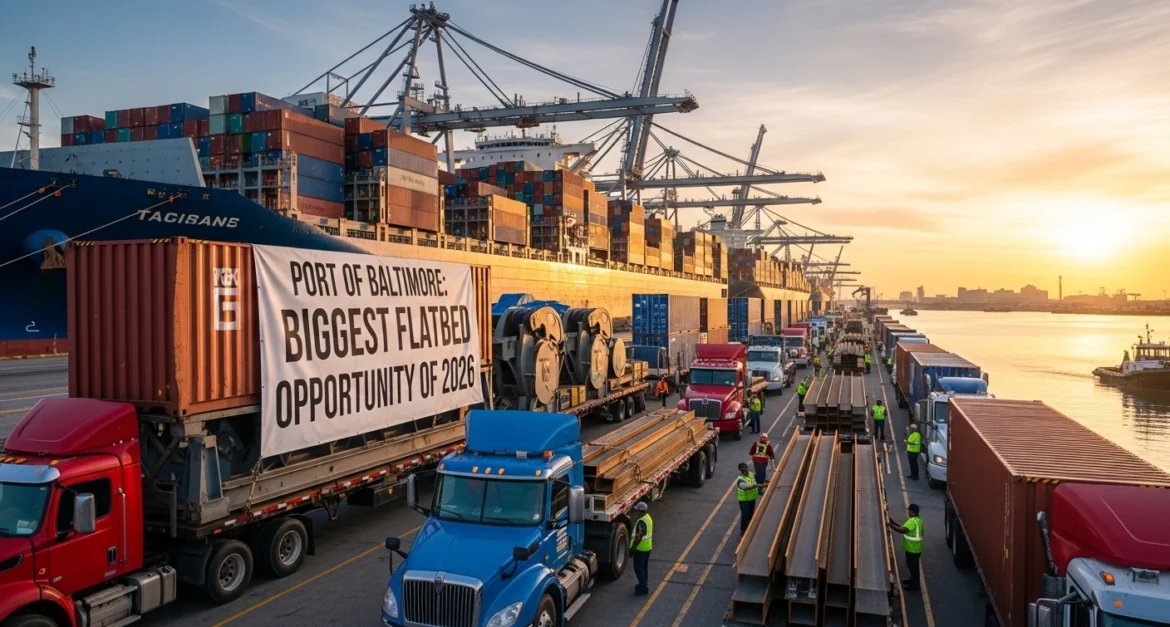
Port of Baltimore Cargo Is the Biggest Flatbed Opportunity of 2026 — Are You Running It?
Every spring, smart flatbed carriers stop chasing and start positioning. They don’t wait for the market to tell them where the freight is — they already know. And right now, every carrier who knows where to look has their eyes locked on one place.
The Port of Baltimore.
Not because it’s trendy. Because the data, the calendar, and the freight volume all point to the same conclusion: Baltimore is producing the most high-value, flatbed-specific cargo in the country right now — and the window to capitalize is wide open.
What Cargo Goes Through the Port of Baltimore?
This is the question most carriers never ask — and it’s exactly why they miss this market.
Port of Baltimore cargo is uniquely and almost exclusively flatbed freight. While other East Coast ports move containers packed with consumer goods, Baltimore moves machinery. Heavy, oversized, permit-required machinery that physically cannot fit inside a dry van.
The roster of manufacturers shipping through Baltimore’s Dundalk and Seagirt terminals reads like the hall of fame of American heavy industry:
- John Deere — combines, planters, sprayers
- CNH Industrial (Case IH & New Holland) — 14,000 to 16,000 units annually through the port alone
- AGCO (Fendt & Massey Ferguson) — with an assembly facility just 27 miles away
- Caterpillar, CLAAS, and Komatsu — excavators, wheel loaders, and construction-grade iron
Every single one of those units rolls off a ro/ro vessel and immediately needs a flatbed, step-deck, or RGN to move it overland. That is a freight environment purpose-built for open-deck carriers — and it runs at full intensity every single spring.
What Is the Port of Baltimore Used For — And Why Does It Matter to Flatbeds?
Baltimore holds the title of #1 ro/ro port in the United States for farm and construction machinery — a position it has owned for years with no sign of losing it. The port’s geographic advantage is the foundation: it sits 150 miles closer to Midwest markets than any other mid-Atlantic harbor, making it the default import point for ag equipment destined for Ohio, Indiana, and Illinois farm country.
The result for flatbed carriers is a freight market with three powerful characteristics: predictable volume, premium cargo, and shippers who aren’t price-sensitive when planting season is breathing down their neck.
Our flatbed transportation services are specifically built for this type of high-value, time-sensitive cargo movement — and Baltimore is exactly where that expertise pays off.
Has the Port of Baltimore Reopened After the Bridge Collapse?
Yes — and the rebound is creating a freight surge on top of an already-peak season.
After the Francis Scott Key Bridge collapse in March 2024 disrupted port access, vessel traffic was rerouted and freight shifted to competing ports across the region. Now that the channel is fully cleared and operations at Dundalk and Seagirt terminals are completely restored, that displaced volume is flowing back — arriving right in the middle of the busiest flatbed season of the year.
For carriers, this means a double surge: the normal spring import peak plus the rebound of freight that spent months moving elsewhere. That doesn’t happen often. When it does, the carriers who are positioned win big.
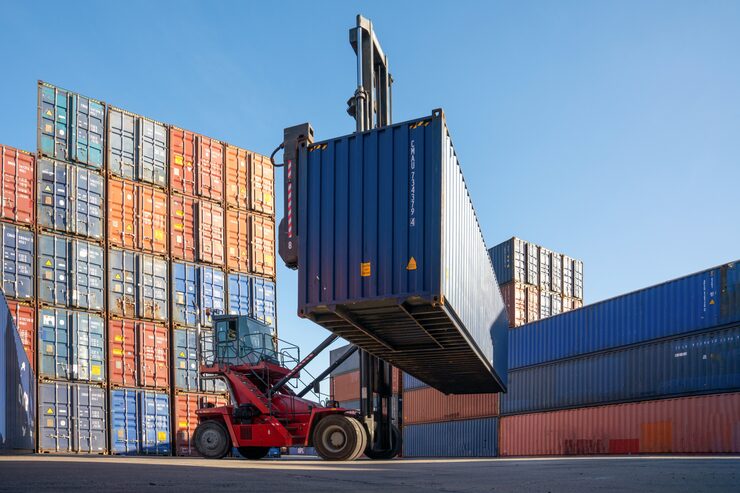
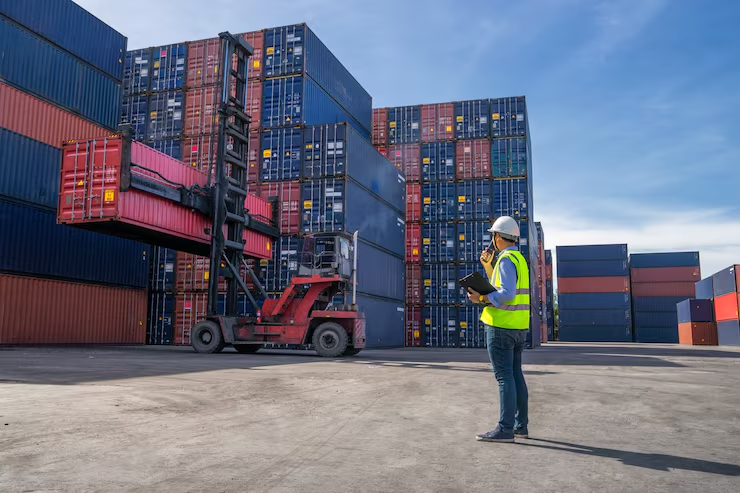
For the container and drayage side of port freight, our seamless port-to-door container transportation handles the terminal-to-truck movement — keeping freight flowing without bottlenecks while flatbeds handle the heavy iron.
How Does Cargo Get to Dundalk Terminal — And What Happens Next?
Dundalk Terminal is ground zero for ro/ro operations in Baltimore. Vessels dock, ramps drop, and equipment rolls off — tractors, combines, excavators, and wheel loaders that were loaded in Europe or Asia and are now ready for North American distribution.
From Dundalk, that freight doesn’t wait. It fans out across a wide geography immediately:
- West → Ohio, Indiana, Illinois — farm country ahead of planting season
- South → Virginia, North Carolina, South Carolina — construction corridors ramping up
- North → Pennsylvania, New York, New England — infrastructure and construction freight
- Local → Maryland government, military, and infrastructure contracts
This lane diversity is what makes Port of Baltimore cargo so powerful for flatbed operators. You can run a loaded mile in almost any direction and find real freight waiting. Deadhead drops, revenue per mile climbs, and the best carriers build full two-way lane strategies instead of one-way shots.
For freight that moves in shorter legs from port to staging yard before the long-haul move, drayage services bridge that critical first mile — so nothing sits idle at the terminal.
What Do the Numbers Say Right Now?
The market data confirms what carriers on the ground are already feeling:
- Flatbed load post volumes hit the highest weekly total of 2026 — up nearly 47% versus the same period last year
- The national flatbed load-to-truck ratio climbed 10% to 76.39
- Spot rates are running at $2.31 per mile — 12% higher than this time last year and 15% above the five-year average
That last number is the one that matters most. Rates aren’t just recovering — they’re running well above the historical baseline. And unlike a random rate spike, this one is backed by real structural demand: import volume, seasonal urgency, and a recovering port all firing at the same time.
What Equipment Do You Need to Work This Market?
Not every truck is built for Baltimore’s freight. Here’s what actually moves Port of Baltimore cargo:
- Standard flatbeds — machinery components, steel coils, smaller construction equipment
- Step-decks — taller units that can’t clear bridge height on a standard flat
- RGNs (Removable Gooseneck) — the largest combines, excavators, and heavy construction machinery
- Permits & escorts — required for oversize loads on Maryland and Virginia state routes
Carriers running step-decks or RGNs access the highest-rate freight in the market. Standard flatbed operators still find strong loads — but the premium tier belongs to open-deck specialists ready for oversized moves.
The Window Is Open — Right Now
This isn’t a trend. It’s not hype. Port of Baltimore cargo is a structural freight opportunity that runs on the agricultural calendar, ro/ro import cycles, and spring construction demand — and it rewards carriers who show up prepared every single year.
The port that moves the machinery that moves America is firing on all cylinders in 2026.
Position your trucks. Run the lanes. The best flatbed market of the year is waiting.
👉 Explore our flatbed services and let’s move your freight today.